Peet’s Coffee: History, Products & Brewing Guide

*We may earn a commission for purchases made using our links. Please see our disclosure to learn more.
The story of specialty coffee in America begins not in Seattle, but in a modest Berkeley storefront where a Dutch immigrant decided the richest country in the world deserved better than the lackluster coffee dominating American cups. Founded in 1966 by Alfred Peet in Berkeley, California, this pioneering coffee company introduced Americans to darker roasted Arabica coffee and fundamentally changed the nation’s coffee culture. What started as a single shop has evolved into a specialty coffee empire with over 250 retail locations across 13 states and products available in more than 14,000 grocery stores nationwide.
“I came to the richest country in the world, so why are they drinking the lousiest coffee?”
— Alfred Peet, reflecting on arriving in 1950s America (Peet’s Coffee History)
Key Takeaways
- Peet’s Coffee revolutionized American coffee culture by introducing dark-roasted, high-quality Arabica beans to a market dominated by mass-produced coffee
- The company was founded in 1966 in Berkeley, California, predating and inspiring the creation of Starbucks
- Major Dickason’s Blend, developed in 1969 with a customer, remains the company’s bestselling coffee
- The company maintains traditional hand-roasting techniques in small batches to ensure freshness and quality
- Peet’s currently operates over 250 retail locations and distributes products through thousands of grocery stores across all 50 states
- In August 2025, Keurig Dr Pepper announced it would purchase Peet’s Coffee for $18.4 billion
Recommended Peet’s Coffee Products
Peet’s Coffee Major Dickason’s Blend


Peet's Coffee Major Dickason’s Blend is a bold, dark roast ground coffee crafted from 100% Arabica beans for a rich, full-bodied experience. Developed by Alfred Peet alongside his most discerning customer, this iconic blend delivers deep, complex flavors with a smooth yet robust finish. Perfectly ground for drip machines and pour-over brewing, Peet's Coffee Major Dickason’s Blend is ideal for coffee lovers who crave intensity without bitterness. Backed by Peet’s commitment to responsible sourcing, every cup reflects over 50 years of coffee-roasting mastery.
Peet’s Coffee has long been known for its uncompromising approach to quality, and Major Dickason’s Blend stands as one of its most celebrated creations. This dark roast is loved for its depth, balance, and unmistakably bold character that sets it apart from ordinary blends. Unlike overly smoky dark roasts, Major Dickason’s Blend maintains complexity and smoothness, making it enjoyable from the first sip to the last.
- Flavor: Bold, rich, and complex dark roast with a smooth finish
- Quality: Made from 100% Arabica beans and expertly hand-roasted
- Versatility: Ideal for drip coffee makers and pour-over methods
- Roast Strength: May be too strong for light roast drinkers
- Form: Ground coffee limits grind-size customization
- Price: Slightly higher than standard grocery-store brands
Peet’s Coffee Major Dickason’s Blend Dark Roast K-Cup Pods
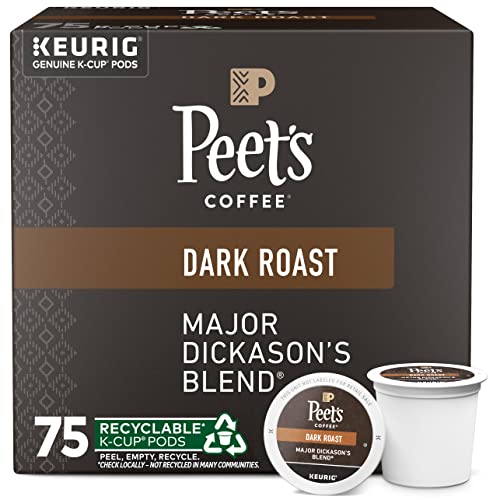

Peet's Coffee Major Dickason’s Blend Dark Roast K-Cup Pods deliver the iconic, bold flavor Peet’s is known for in a convenient single-serve format. Crafted from 100% Arabica coffee beans, this dark roast is rich, robust, and full-bodied, offering deep, complex flavor with every cup. Designed for compatibility with all Keurig K-Cup brewers, Peet's Coffee K-Cup Pods make it easy to enjoy a consistently satisfying coffee at home or in the office. With recyclable pod materials and responsible sourcing practices, Peet’s combines convenience, quality, and sustainability in one box.
Peet’s Coffee has built a reputation on delivering bold, uncompromising flavor, and Major Dickason’s Blend is a perfect example of that legacy. In K-Cup form, this dark roast retains the depth and richness that fans expect while offering the convenience of single-serve brewing. Each pod produces a smooth yet powerful cup, making it a favorite for mornings when you need a strong, reliable coffee.
- Flavor: Bold, full-bodied dark roast with rich, complex taste
- Convenience: Compatible with all Keurig K-Cup brewers
- Value: Large 75-count box ideal for frequent coffee drinkers
- Strength: May be too intense for mild coffee preferences
- Waste: Recycling depends on local facilities
- Customization: Limited control over brew strength compared to ground coffee
Peet’s Coffee USDA Organic French Roast


Peet's Coffee USDA Organic French Roast is a deep, dark roast ground coffee made from 100% Arabica beans and certified USDA Organic. This bold blend delivers intense flavor notes of chocolate truffle, smoke, and caramel, creating a rich and powerful cup with a smooth finish. Carefully sourced and meticulously roasted, Peet's Coffee French Roast reflects a dedication not only to exceptional taste but also to sustainable farming practices. Pre-ground for convenience, it’s ideal for drip coffee makers and pour-over brewing, offering a premium organic coffee experience in every brew.
Peet’s Coffee Organic French Roast is designed for coffee lovers who appreciate depth, intensity, and authenticity. Unlike standard dark roasts that can taste overly bitter, this blend balances smoky richness with subtle sweetness, resulting in a bold yet refined cup. The organic certification ensures that the coffee is grown without synthetic pesticides while still meeting Peet’s strict quality standards.
- Flavor: Bold dark roast with notes of chocolate truffle, smoke, and caramel
- Organic Quality: USDA Organic certified and 100% Arabica beans
- Craftsmanship: Expertly hand-roasted with over 50 years of experience
- Roast Intensity: Very dark profile may be too smoky for some drinkers
- Grind Type: Ground coffee limits flexibility for different brew methods
- Caffeine Sensitivity: Strong flavor may feel intense for lighter coffee preferences
Peet’s Coffee Major Dickason’s Blend Dark Roast Keurig K-Cup Pods


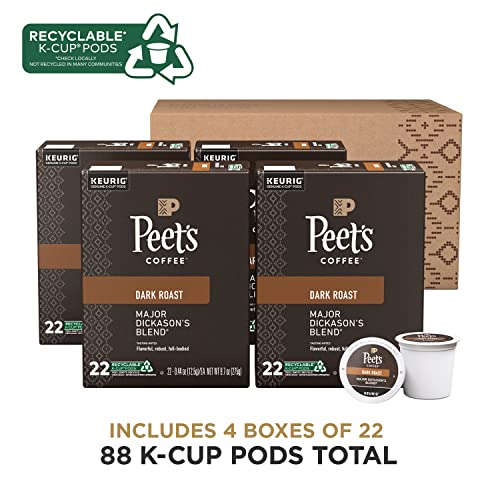
Peet's Coffee Major Dickason’s Blend Dark Roast Keurig K-Cup Pods bring Peet’s signature bold flavor to a convenient, value-packed multi-box set. Made from 100% Arabica coffee, this iconic dark roast is rich, robust, and full-bodied, offering deep complexity with every brew. Designed to work seamlessly with all Keurig K-Cup brewers, Peet's Coffee K-Cup Pods deliver consistent quality and ease for home or office use. With recyclable pods and Peet’s commitment to responsible sourcing, this 88-count pack is ideal for serious coffee drinkers who value both flavor and convenience.
Peet’s Coffee Major Dickason’s Blend has earned its reputation as one of the most recognizable dark roasts on the market. In Keurig K-Cup form, it delivers the same bold and satisfying flavor profile that fans love, without sacrificing convenience. The 88-count multi-box option is especially appealing for households or offices where quality coffee is a daily essential.
- Flavor: Bold, full-bodied dark roast with rich, complex taste
- Value Pack: 88 K-Cup Pods across four boxes for long-lasting supply
- Compatibility: Works with all Keurig K-Cup brewers
- Intensity: Strong dark roast may not suit light coffee preferences
- Waste Handling: Recycling availability varies by location
- Brew Control: Limited customization compared to grinding fresh beans
The Dutch Immigrant Who Changed American Coffee
Alfred Peet was born in the Netherlands on March 10, 1920, where he learned the coffee trade working in his father’s business. His journey through the global coffee industry took him from London, where he apprenticed at Twinings, to Indonesia, where he discovered the rich, dark-roasted coffee that would inspire his life’s work. When Peet moved to San Francisco in 1955, he was shocked by the quality—or lack thereof—of American coffee.
The coffee Americans drank in the 1960s bore little resemblance to the aromatic, full-bodied brews Peet had experienced in Europe and Asia. National brands had been cutting costs by incorporating increasing amounts of cheap robusta beans, resulting in weak, bitter coffee typically sold in vacuum-packed cans. The standard brewing method involved percolators, which further degraded whatever flavor remained in the already inferior beans.
Frustrated by this state of affairs, Peet opened his first shop on April 1, 1966, at the corner of Vine and Walnut streets in Berkeley, near the University of California campus. He invested the inheritance from his father into a 25-pound roaster and 10 pounds of Colombian coffee beans, determined to show Americans what real coffee could taste like.
The Philosophy of Freshness and Quality
From the beginning, Peet operated on principles that would become fundamental to the specialty coffee movement. He insisted on sourcing only high-quality Arabica beans from premium growing regions. These beans underwent a darker, longer roasting process than Americans were accustomed to—a technique that emphasized the coffee’s natural oils and developed complex, bold flavors.
Central to Peet’s philosophy was the concept of freshness. He promoted the belief that there should be the shortest distance possible between the roaster and the customer. This meant roasting beans in small batches and selling them quickly, ensuring customers received coffee at its peak flavor. The original Berkeley location featured a roaster right in the shop, allowing customers to witness the process and smell the freshly roasted beans.
Not everyone immediately appreciated Peet’s darker roasts. Some customers complained the coffee tasted “burnt” compared to what they knew. But the brew found its audience among students, artists, writers, and musicians—people willing to explore new tastes and appreciate the craftsmanship behind each cup. The shop didn’t just sell coffee; it educated customers about origin, roasting, and brewing methods, transforming coffee from a simple morning beverage into an experience worth understanding.
Creating Legendary Blends
In 1969, a loyal customer named Key Dickason, a retired army sergeant, approached Peet with an idea for a new blend. The two collaborated intensively, sampling countless combinations of beans from different regions until they achieved what they considered perfection. The resulting blend was so exceptional that Peet decided to honor his friend not just by using his name, but by promoting him from sergeant to major. Thus Major Dickason’s Blend was born.
This blend exemplifies Peet’s approach to coffee blending—combining beans from multiple premium origins, each contributing distinctive characteristics while harmonizing into a smooth, balanced cup. Major Dickason’s combines the best origin coffees from the world’s premier growing regions, creating what has become the company’s all-time bestseller and a coffee that epitomizes the Peet’s style: flavorful, deeply roasted, and satisfying.
Other signature blends followed, each crafted with the same meticulous attention to detail. House Blend, created by Peet himself, served as many customers’ introduction to the Peet’s style—a carefully balanced Latin American blend that was both approachable and distinctly superior to mass-market alternatives. French Roast pushed the boundaries of dark roasting, selecting only the densest, most flavorful beans capable of withstanding intense heat. Garuda Blend celebrated the diverse flavors of Indo-Pacific coffees, reflecting Peet’s time in Indonesia.
The Starbucks Connection
The relationship between Peet’s and Starbucks represents one of the most significant connections in American coffee history. In 1971, three young entrepreneurs from Seattle approached Peet to learn about the coffee business. Jerry Baldwin, Gordon Bowker, and Zev Siegl spent time in Berkeley studying Peet’s methods, learning about roasting, blending, and the importance of quality beans.
When they opened the first Starbucks location in Seattle’s Pike Place Market that same year, they sold Peet’s coffee exclusively for the first 18 months. Peet supplied the beans and provided ongoing guidance as the Seattle company established itself. For two years he provided them with training as well as the roasted coffee beans for their new venture, a company called Starbucks.
The connection deepened in 1984 when Jerry Baldwin purchased Peet’s four locations. By 1987, Baldwin made a pivotal decision: he sold his shares in Starbucks to Howard Schultz to focus entirely on Peet’s. While Starbucks went on to become a global phenomenon, Peet’s maintained its commitment to smaller-batch, higher-quality coffee, positioning itself as the connoisseur’s choice in the specialty coffee market.
Expansion and Evolution
For decades, Peet’s maintained a deliberately modest retail footprint, with Alfred Peet himself believing the company should remain small to preserve quality. Even after selling the business in 1979, Peet continued as a consultant and coffee buyer, ensuring his standards persisted. The original location at Vine and Walnut remains open today, serving as both a functioning coffee shop and a living museum of the specialty coffee revolution.
The company’s growth philosophy changed in the late 1990s and early 2000s. By 2001, Peet’s had expanded to 57 retail stores and launched a successful initial public offering, raising $24.6 million. The company balanced expansion with maintaining the neighborhood feel of individual stores and prioritizing quality over mere consistency. Employees received benefits and stock options, fostering a culture of investment in the product and customer experience.
In 2012, a significant corporate shift occurred when JAB Holding Company acquired Peet’s for $977.6 million, taking the company private. This marked the beginning of an acquisition strategy that would expand Peet’s portfolio beyond its core business. The company acquired Mighty Leaf Tea in 2014, bringing premium tea manufacturing into the family. In 2015, Peet’s added Stumptown Coffee Roasters and Intelligentsia Coffee & Tea—both founded by former Peet’s employees—further cementing its position in the craft coffee world.
The Modern Coffee Experience
Today’s Peet’s Coffee maintains the principles Alfred Peet established nearly 60 years ago while adapting to modern consumer preferences and distribution channels. The company offers freshly roasted beans, brewed coffee, espresso beverages, and bottled cold brew. Products reach customers through multiple channels: retail coffeebars, grocery stores, online ordering, and mail-order subscriptions.
The roasting process remains central to the Peet’s identity. The company employs only three Roastmasters in its history, with current Roastmaster Doug Welsh carrying on a tradition of 10,000-hour training programs that ensure consistency and quality. Each batch is hand-roasted and sealed immediately after roasting to preserve freshness. This commitment to craft distinguishes Peet’s in an era of industrial coffee production.
Product innovation has expanded the lineup while respecting the core dark-roast heritage. The Bright Collection introduced lighter, fruit-forward coffees for customers seeking different flavor profiles. The Big Bang blend, created for the company’s 50th anniversary, redefined what a medium roast could achieve—full-flavored and vibrant while still distinctly Peet’s. Seasonal offerings like the annual Holiday Blend allow roasters to showcase exceptional limited-release coffees.
Sustainability and Social Responsibility
Modern Peet’s extends its founder’s commitment to quality into the realm of social and environmental responsibility. The company partners with Enveritas to conduct over 20,000 sustainability audits annually across its coffee supply chain, ensuring ethical practices extend throughout its sourcing network. This approach goes beyond simple certification labels to create meaningful relationships with coffee farmers and communities.
The company sources only from the top 1% of coffee farmers worldwide, building long-term partnerships that support both quality and sustainable livelihoods. This selective sourcing ensures superior beans while providing farmers with reliable markets for their premium crops. The focus on arabica beans from high-altitude growing regions means working with farmers who cultivate coffee in challenging conditions that produce denser, more flavorful beans.
Union Activity and Worker Relations
Recent years have seen significant labor organizing among Peet’s employees. In January 2023, workers at the North Davis location became the company’s first unionized shop in the United States. This was followed by successful union votes at multiple California locations in Berkeley and Oakland, as well as a Portland, Oregon location. These developments reflect broader trends in the coffee industry as workers seek greater voice in workplace conditions and company decisions.
A New Chapter
In August 2025, the coffee industry witnessed another major development when Keurig Dr Pepper announced it would purchase Peet’s Coffee for $18.4 billion. The companies plan to split into two U.S.-listed firms following the merger, suggesting significant structural changes ahead for the specialty coffee pioneer. This acquisition represents the latest chapter in Peet’s ongoing evolution from a single Berkeley shop to a major player in the American coffee landscape.
The Legacy of Alfred Peet
Alfred Peet passed away on August 29, 2007, at age 87, but his influence on American coffee culture remains immeasurable. Among coffee historians, Peet has been called “the Dutchman who taught America how to drink coffee”. His insistence on quality, freshness, and craftsmanship established standards that define specialty coffee today.
The original Berkeley location still attracts coffee lovers who want to experience where the American craft coffee movement began. A small museum in the back of the shop features old photographs, newspaper clippings, and vintage coffee-making equipment, preserving the history of a revolution that started with one person’s refusal to accept mediocrity.
Peet’s mentorship extended far beyond the Starbucks founders. Numerous coffee entrepreneurs credit him with teaching them the art of roasting and inspiring their own ventures. His generosity in sharing knowledge helped seed specialty coffee businesses across the country, each carrying forward his commitment to excellence.
Distinctive Product Range
The current Peet’s lineup reflects both heritage and innovation. Major Dickason’s Blend remains the flagship, but customers can choose from dozens of single-origin coffees and blends spanning light to dark roasts. The company offers whole beans, ground coffee, K-Cup pods, and cold brew to meet different brewing preferences and convenience needs.
The decaf selection receives particular attention, with Decaf Major Dickason’s Blend using the same premium beans as the original, processed to remove caffeine while preserving flavor, body, and aroma. This commitment to quality in decaffeinated coffee addresses a market often overlooked by premium roasters.
Seasonal and limited-release coffees keep the lineup dynamic. The annual Holiday Blend has become a tradition, with roasters carefully selecting and combining coffees that capture the spirit of the season. These special releases allow Peet’s to showcase exceptional coffees that might be available in limited quantities or to experiment with different roasting profiles and combinations.
Brewing Guidance and Customer Education
Peet’s maintains Alfred Peet’s original commitment to customer education. The company provides detailed brewing guidance, recommending different grind sizes and brewing methods for various coffee types. French press brewing suits dark roasts, bringing out rich, complex flavors through direct infusion. Pour-over methods highlight subtle nuances in lighter, brighter coffees. Espresso preparation requires fine grinding and high pressure to extract the concentrated flavors that define this brewing style.
The standard recommendation calls for two tablespoons of ground coffee per six ounces of water, though preferences vary. Cold, filtered water produces the best results, and coffee tastes best within 30 minutes of brewing, when volatile aromatics remain most pronounced. These guidelines help customers achieve café-quality results at home, democratizing the specialty coffee experience.
The Competitive Landscape
Peet’s operates in an increasingly competitive specialty coffee market. While Starbucks dominates in terms of sheer size and ubiquity, Peet’s positions itself as the quality alternative—smaller, more focused, and committed to the craft that started the specialty coffee movement. The acquisition of Stumptown and Intelligentsia strengthened this positioning, creating a portfolio of respected brands under common ownership.
The company competes not just with large chains but with the third-wave coffee movement—independent roasters emphasizing single-origin beans, light roasts, and detailed sourcing information. Peet’s responds by highlighting its heritage while introducing products like the Bright Collection that appeal to evolving tastes. The challenge lies in maintaining the traditional dark-roast identity while adapting to customers who may prefer lighter, more fruit-forward profiles.
Distribution through grocery stores extends reach beyond coffeebar locations, making Peet’s accessible to customers who want quality coffee at home without visiting a specialty shop. This multi-channel approach—retail locations, grocery distribution, online sales, and subscriptions—creates resilience against market shifts while serving different customer preferences.
Looking Forward
As Peet’s enters a new era under Keurig Dr Pepper ownership, questions arise about how the pioneering brand will evolve. Will the emphasis on hand-roasted, small-batch coffee persist? Can the company maintain its craft credentials while potentially scaling operations? How will the brand balance its heritage with the need to appeal to new generations of coffee drinkers?
The original vision of Alfred Peet—bringing exceptional coffee to American consumers through careful sourcing, expert roasting, and customer education—remains relevant. Coffee quality continues to matter to discerning consumers willing to pay premium prices for superior products. The challenge for Peet’s lies in preserving the standards that made it special while navigating corporate ownership and market pressures.
Conclusion
From a single Berkeley storefront in 1966 to a nationwide presence with hundreds of locations, Peet’s Coffee has fundamentally shaped how Americans think about and consume coffee. The company introduced concepts now taken for granted in specialty coffee: fresh roasting, high-quality arabica beans, dark roasts that emphasize rather than hide flavor, and the importance of the relationship between roaster and customer.
The Major Dickason’s Blend story—a collaboration between founder and customer resulting in an enduring bestseller—captures the essence of what made Peet’s different. This wasn’t coffee as commodity but as craft, requiring skill, judgment, and care at every stage from sourcing to roasting to brewing. Alfred Peet’s refusal to accept the mediocre coffee dominating 1960s America sparked a revolution that transformed the industry.
Today, specialty coffee shops exist in virtually every American city, serving drinks that would have been exotic rarities before Peet opened his doors. While Starbucks may be more visible, Peet’s can claim the deeper heritage—the original vision that showed Americans coffee could be so much more than a caffeine delivery system. As the company continues to evolve, its founding principles of quality, freshness, and craftsmanship remain as relevant as ever to coffee lovers seeking the best possible cup.
Frequently Asked Questions
What makes Peet’s Coffee different from other coffee brands?
Peet’s distinguishes itself through its commitment to hand-roasting small batches of premium arabica beans using techniques developed by founder Alfred Peet in the 1960s. The company emphasizes darker roasting profiles that develop rich, complex flavors, and maintains that freshness is critical to quality by minimizing time between roasting and consumption. This artisanal approach contrasts with mass-market industrial coffee production.
Is Peet’s Coffee stronger than regular coffee?
The perceived strength of Peet’s Coffee comes from its dark roasting process, which creates bold, intense flavors with pronounced oils and aromatic compounds. However, darker roasting actually reduces caffeine content slightly compared to lighter roasts. The “strength” refers to flavor intensity rather than caffeine level. The full-bodied, robust taste represents Peet’s signature style, reflecting European coffee traditions Alfred Peet brought to America.
Where can someone buy Peet’s Coffee products?
Peet’s Coffee is available through multiple channels: over 250 retail coffeebar locations across 13 states, more than 14,000 grocery stores nationwide, the company’s website for online ordering, and subscription services that deliver fresh-roasted beans directly to customers. Products include whole beans, ground coffee, K-Cup pods, and bottled cold brew, offering options for different brewing preferences and convenience needs.
What is the relationship between Peet’s Coffee and Starbucks?
Alfred Peet served as mentor to Starbucks founders Jerry Baldwin, Gordon Bowker, and Zev Siegl in 1971, teaching them roasting techniques and supplying beans for the first Starbucks location. In 1984, Baldwin purchased Peet’s and later sold his Starbucks shares to focus on Peet’s. While Starbucks became a global giant, Peet’s maintained its focus on smaller-batch, craft coffee, positioning itself as the quality-focused original that inspired the specialty coffee movement.
What are the most popular Peet’s Coffee blends?
Major Dickason’s Blend remains the all-time bestseller, developed in 1969 as a collaboration between Alfred Peet and customer Key Dickason. This dark roast combines premium beans from multiple growing regions for a smooth, balanced cup. Other popular choices include House Blend, serving as many customers’ introduction to Peet’s style; French Roast, the darkest roast with pronounced smoky notes; and seasonal offerings like the annual Holiday Blend. Each blend reflects the company’s commitment to sourcing exceptional beans and expert roasting.